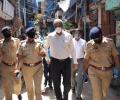
'These are challenging times and we get energised by that.' 'I don't feel that 'I am tired now and I should relax', because even if someone calls us at 12 o'clock I have to answer his call.'

'The success of the country's economic policies is affirmed by receipt of FDI of $15 billion last year, the highest in the Asia-Pacific after China and India, and well ahead of Indonesia, Australia, Singapore, Malaysia and Thailand,' notes Ambassador Talmiz Ahmad.

If the impact of the Greece crisis spreads across Europe and parts of the world which are more interconnected than ever before, India cannot hope to be insulated, says Paranjoy Guha Thakurta.

'While military acts such as the Uri surgical strikes are one option, cultural, economic and diplomatic isolation should also be part of the arsenal,' argues Sankrant Sanu.

Prime Minister Narendra Modi on Thursday address Members of the British Parliament in London where he promised to open more doors of cooperation between the two countries and delved on issues like terrorism and United Nations reforms.

'With his envious academic record, extraordinary research calibre and unparalleled work experience, we can trust him to become the first Indian -- fully Indian, not one of those Americans of Indian origin -- to win the Nobel Prize in Economics,' says Sudhir Bisht.
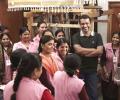
Anshu Gupta, the founder of Goonj, has transformed the culture of giving in the country. He has for 15 years now, worked tirelessly to bridge the gap between the haves and the have-nots, by making discarded materials a resource for the poor. His weapon, he says, is 'cloth as a tool of social change.'

The economy could return to 8% growth by the end of 2017-2018, says Arvind Panagariya, vice-chairman NITI Aayog.
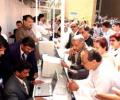
India needs to come up with new ideas to make the Pravasi Bharatiya Divas more appealing to overseas Indians. The Diasporas talents should be used for the country's development, says Thomas Abraham, founder of the Global Organisation of People of Indian Origin

Constantly evolving rules and anomalies over tax treatment have constrained corporate programmes in the first year that the government's CSR mandate has been in force.

In spite of irritants and hiccups in the relationship, a few deliverables are expected of the prime minister's visit to China, says Rup Narayan Das.

'What lies at the core of Abe's stance is Japan's crisis management ability amid the increasingly tense North Korean situation,' says Rajaram Panda.

Prime Minister Manmohan Singh on Friday disagreed with those in the Congress who were dismissive of the challenge posed by Narendra Modi but asserted that the party would approach the 2014 Lok Sabha polls with self-confidence, irrespective of the results of the just concluded elections in five states.

AAP candidates from Mumbai, Medha Patkar and Meera Sanyal, are poised to play a crucial and complementary role. While Patkar gives voice to the suffering of people at the grassroots, Sanyal is articulating the key principles that could build a more just and equitable society or economy, says Rajni Bakshi.

Mudra Bank will be a Rs 20,000-crore institution, which would "primarily be responsible for refinancing all micro-finance institutions.

This is the full text of Prime Minister Manmohan Singh's address to media persons ahead of his interaction with them in New Delhi on Friday

'Emboldened by the BJP victory, the upper castes feel they must assert themselves and regain dominance over the rural power structure.'

China's malfunctioning stock markets remained semi-frozen.

Following her spat, 'Aunty National' Irani took to Facebook to speak out against her detractors. Here's the Facebook post in response to her critics which Rediff.com represents verbatim:

The government is following a path where it will not be irresponsible or profligate with public money but will intervene in the interest of the poor

'Give time to the 2013 Act to work. I not only think that the 2013 law is workable, I believe that the 2013 law is a compromise, a balanced middle path and protects the interests of land owners and livelihood losers.'

Historian Romila Thapar, while delivering the 3rd Nikhil Chakravartty Memorial Lecture organised by The Book Review Literary Trust in New Delhi, delved on the growing hesitation among free-thinking Indians.

'India cannot expect to be insulated from the crisis. Europe is India's biggest trading partner with two-way trade of E72.5 billion or Rs 530,000 crore last year,' says Paranjoy Guha Thakurta.

'If you look at the entire protest on April 2, you will find it was not only about the Atrocities Act dilution, but the accumulated anger of the Dalit community against the BJP over the last four years.'
If you can have caste and faith based parties, why can't there be a gender based one as well, asks T C A Srinivasa-Raghavan.

Anjuli Pandit wants to use her skills to educate more and more Indians, says Chaya Babu
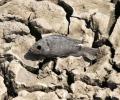
Growing and harvesting trees for productive and economic uses are once again dead in the water, says Sunita Narain.
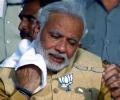
Critics argue that much more could have been done and that the government was slow to react to many events.
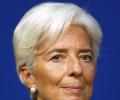
The IMF chief listed three key policy areas for women's empowerment as the education, getting a job and having a family.

While Congress-ruled states such as Kerala, Karnataka and Assam expressed fears about the sudden demise of the planning process and wondered what it would be replaced with, also worrying about the immediate implications on annual Plan outlays, Andhra Pradesh said it was considering setting up its own NITI Aayog.

The State is trying to curb the students movements, therefore, there are suspicions against some of the Subramanian report on education's recommendations, says Mohammad Sajjad.

In a note to his students titled 'In a Background of Elections - The Development Debate', Dr Frazer Mascarenhas, principal of Mumbai's St Xavier's College, slams Narendra Modi's Gujarat and is in all praise of United Progressive Alliance's Rojgar Yojana and the Food Security Act

'In the first elections, Hindutva forces got only 6% of the votes and won only 10 seats.' 'It was a great defeat for them.' 'They have held that grouse against Nehru since then.'
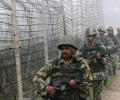
'As India progresses and takes an increasingly hardline approach to Pakistani hostility, the young and restless population of Pakistan, sooner than later, will demand 'Gazwa e Hind' (conquest of India),' warns Colonel Anil A Athale (retd).

Annabel Mehta, Sachin Tendulkar's mother-in-law, has dedicated her life to working with the Beautiful People of the other half of Mumbai without whom the city would neither exist nor thrive. Vaihayasi Pande Daniel met the amazing lady who was awarded the Member of the Order of the British Empire for her service to underprivileged communities.
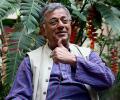
'He had a continuing interest in life, people, and the society in which he lived,' remembers Shyam Benegal, who collaborated with the polyglot playwright and actor through the 1970s and remained his friend for more than five decades.

At the Paris climate change summit, there is talk of restricting temperature rise to 1.5?C instead of 2?C, which has been negotiated so far. This would give India less space to grow by limiting carbon emissions further, reports Darryl D'Monte, reporting exclusively for Rediff.com from the French capital.

'As the interest rates rise, people are going to say why should I be taking big risks when I can get 4 to 5 per cent in a bank account.' 'So, I think you have to change your thinking.' 'You need to look at the balance sheet, look at dividends.' 'These issues that have been ignored.'

Gimmicks such as appointing high-profile brand ambassadors like Sachin Tendulkar will not work.
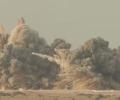
'A conventional war is not in fashion today and not seen as being able to deliver the objective.' 'Perhaps surgical strikes that are deeper, this time not on Pakistan's terrorist facilities, but on Pakistan army facilities.' 'The nation has to be prepared for losses.' 'War is not something that can be pussyfooted around.' 'If we go for limited number of posts in Kashmir, these are very difficult posts to capture and very difficult operations.' 'Be prepared for 200 to 300 killed.'
